Solar Panels

Welcome and thank you to our second guest blogger Randy Mikula.

Buying Solar:   One family’s experience:   by Randy Mikula

Solar is not for everyone, and to find out if it is for you, it might be useful to hear our experience.   I think that the first myth that needs to be dispelled is that going solar makes economic sense.   It does not.   When investigating a solar purchase, you will be confronted with a bewildering variety of claims for payback periods and return on investment calculations.    My advice is to ignore all of them…….they are based on assumptions and predictions, typically going out 15 to 20 years.    With that time scale, even small changes in predictions about the future cost of electricity will have significant impacts on any estimated payback periods.   It is really best to ignore those graphs and charts that dominate the information package you will receive from companies that will be bidding on your installation.  There is a reason that solar installations have significant government subsidies…….because they don’t make economic sense. Why then, would anyone consider a solar installation?    Answer:   I don’t know!    I can, however, tell you why we installed solar panels.  In Alberta, a significant portion of our electricity is from coal powered generators, and there is a significant level of air pollution associated with burning coal.   We were lucky enough to have some disposable income, and rather than leave that for our children, we thought we would do our bit to reduce some of the environmental downside of coal fired power plants.    We did not believe any of the 15 to 20 year return on investment claims by the suppliers.   
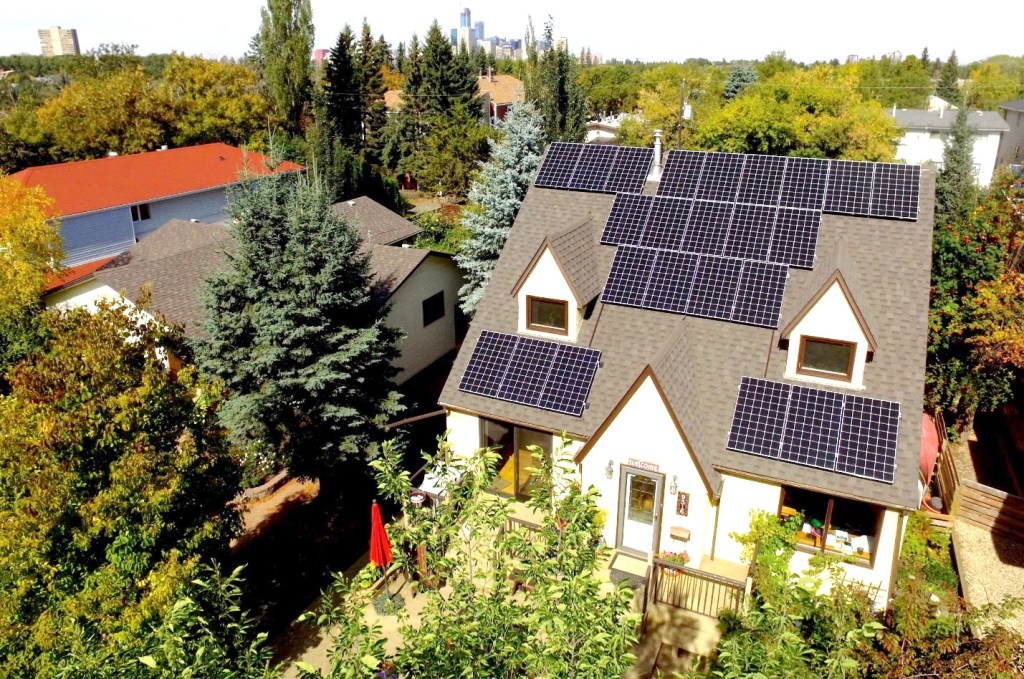
Our Solar installation.  Twenty-four 320watt panels for a total capacity of 7.68kWatts.

Whatever your motivation for going solar, once your decision is made, the real fun begins.    Our adventure began with an internet search of local companies and at the time (late summer of 2018), we quickly narrowed our list down to what we thought were a top 6.    Each of the companies presented different options in terms of the type of solar panel (watts per panel) and the number of panels.    A fairly complex spreadsheet evolved to determine cost per watt generated, panel manufacturer and associated reputation, and finally installation cost.   On top of this, there are two main technical considerations around how the power is delivered to your home and out to the grid.    The solar panels are producing DC (direct current) voltage, while your house and the grid feeding your house are AC (alternating current).   In order to convert your solar panel output to useable electricity, the DC power has to be converted to AC power.    In 2018 there were two options available to achieve this conversion:  microinverters or power optimizers.   The microinverters do the DC to AC conversion at each solar panel, while the power optimizers allow for reasonably efficient transfer of DC power from each panel to a DC to AC inverter installed near your electrical panel inside your house.     There are lots of interesting geeky technical reasons why we went with the power optimizers and the single inverter inside the house but getting into those details is not the intent of this particular soap box tirade.     

My July energy usage broken down by day.   Making way more energy than I am using.

Once you have made that decision about a distributed or single power inverter, it will surprisingly do nothing to limit your choices about which company to do the installation.   That is because most of them will offer either system, although they may have preferences as to which they might recommend to you.    So, now we are down to looking at cost per watt based on the output of the solar panels and their associated costs, including installation.   Sorry…..still no help from me on this because this is a pretty competitive industry and each company will have similar performance and trying to figure out the pros and cons of things like polycrystalline panels versus single crystal panels and output per panel can drive you crazy…….I know I still have a bit of tic from my experience in trying to sort out the best deal.    In the end I determined that it is like buying a TV.    There are quality issues that are largely determined by the price, and once you have determined your price range you might as well make the purchase, cross your fingers,  and then quit looking at the market.   Just like TV’s you will find companies offering say LG or Canadian Solar brand panels, same output, same general description, but different prices….. look closely and you will see that just like TV’s even for the same brand  it is a different model #, so good luck with any head to head comparisons. 

I have to admit that I spent way too much time looking technical details and splitting way too many hairs before I realized that there is no point sweating over a few pennies per installed watt.   In the end I literally just went with the guy I liked the best when I met him on the site visits…..probably not the best advice but after months of calculations I was finally ready to get my system installed and just assumed the industry is pretty competitive in terms of equipment quality.  For my installation, I was lucky because I needed new shingles, so I had my solar panels installed on a new roof.    With the solar panels protecting my shingles, I am expecting this roof to last forever.

Here is the PWRView output for December broken down by day.   Even with my steep roof, it can take time for the snow to fall off the panels. Using way more energy than I am making.

Now for the fun part….saving the planet.    The installation will include an internet link so the company can monitor your system performance and of course so can you.   I have a SolarEdge inverter and it is hooked to the web via my home internet.   You can look at my system performance by going to solaredge.com and typing “mikula” into the monitoring section.   You won’t get the detail of information that I get, but it gives you an idea of my system performance and you can get a sense of the data that is available.   I thought that checking this site would be interesting for about 4 months before the novelty wore off.   After about 16 months it is still fun, but only because a good friend across town has a similar system installed and we are constantly monitoring each others performance and bragging or not depending upon our relative solar output.   Note that if you look at my system data it says that since installation, I have saved over 3400kg of carbon dioxide or planted the equivalent of over 11 trees.   My 7.68 kW of installed power (24x320watt panels) is almost an ideal installation because I have a steep roof slope facing south.   At the equator, an ideal solar panel angle would be flat on the ground……..as you move north, the ideal panel angle gets steeper in proportion to your latitude (the angle of the sun).    My steep roof slope is almost optimum in terms of panel angle for Edmonton and furthermore the steep angle means that snow doesn’t accumulate, but will slide off the panels, allowing me to create power even throughout the winter.    My friend’s installation is on a conventional roof and once the snow falls, his panels are essentially off line, so it is no fun comparing performance for at least 4 months out of the year.   

My total output from the solar edge system data.  Over time, I will see how the solar panel output might deteriorate due to age.   This shows that with my steep angled panels, I can make power in the winter months because my panels are not always covered with snow.

But wait….there is another technology that will help keep you interested in your energy and planet saving efforts  even when the panels are covered with snow.    This is an electricity monitoring device that is often available as an option from your solar installer.   It can be installed and be fun whether you have solar panels or not.   Mine is called Generac PWRVIEW (see above chart).   You can install this in your electrical panel and it will monitor your electrical usage.    With time, some systems can identify what appliance is on line and output what your electricity use is for each identified appliance.   This can be great fun for me and a huge annoyance to the family when I can identify that lights have been left on and can quantify the vampire power draws in the house.   This is also on the internet so power use can be monitored even while on holiday in Saskatchewan  or Hawaii (now you see why it can be a huge annoyance).    That monitoring system cost about $400, and is way more fun than just looking at solar panel output.   After all, you can’t do anything about the solar power, but you can keep lights off and monitor daily electricity use for your lights, computer, washer, dryer, etc.    I would recommend that any solar installation include the add on monitoring system and in fact, the monitoring system might be a good investment even without a solar installation.    The monitoring system will measure solar input as well as household use, and if you are looking at the monitoring system as a start, the solar monitoring option is an easy addition later.   

Here is my power usage and generation for July 22.   Making way more than I am using and you can see two spikes where we were probably doing laundry.   This data can be looked at in real time at much higher resolution and I can see when the tea kettle is turned on, or even a laptop!   Notice that the power generated is chopped at 6kWatts.   That is the limit of my inverter, while my rooftop has the potential to make 7,68kWatts (some wasted production there).   Note the notch in generation where some clouds blocked the sun for a time. 

 Finally, I will share some financial estimates.    My solar installation cost about $22K for 7.68kW of panels, and with $6K in rebates, my cost was $16K.   In 2019, my Generac data showed I saved $747 (and don’t forget the 3400kg of carbon dioxide and 11 trees).  That’s not bad, but less than a 5% return on my $16K.   Take a close look at your electrical bill and you will see that most of the cost is transmission, and not power, so don’t expect any months with no power bill.   And remember, my installation is almost ideal.   As they say, “results may vary”, but be assured they probably will not be as good as mine.   Another surprise (is was for me) is that during a power outage, your solar system will shut down and you will not have power along with your neighbors.   This is because in the event that technicians are working on the grid, they don’t want to be shocked by power coming from a solar system.

Obviously, a lot of this is just my opinion and you need to do your own research, but you should be able to get a lot of satisfaction from reducing at least a small portion of the pollution associated with coal fired power generation.  I think you will be unhappy if you think going solar is a financial investment, but very happy if you see it as an investment in the environment.    

My 6kWatt inverter mounted beside my electrical panel.  The white antenna unit connects the solar edge inverter to the home wifi, and the black antenna just above that connects the PWRView electricity monitor to the home wifi.

Thank you, Randy, for generously sharing and educating us on what a solar panel installation involves, looks like, and yields in terms of benefits at the household level, including fun intangibles such as the pleasure of being able to monitor the family’s energy production and consumption remotely.

Morocco’s Solar Farm – Noor (meaning “light” in Arabic)

That got us curious to learn more about leading solar energy projects, at the country level.

According to a 2019 article by the National Geographic, Morocco is among three “Top of Class” countries on path to meet or exceed their Paris Agreement targets  and in keeping with an overall 1.5C global warming maximum rise. (FYI, the other two countries are The Gambia and India; the full report card article is here https://on.natgeo.com/3aNvX8y.)

According to the article, Morocco is already at 35% of its electricity production through renewable sources, on path toward its National Energy Strategy goal of 42% by 2020 and 52% by 2030. The Noor Ouarzazate complex is credited with being the main reason why Morocco is in this enviable position, through the country’s foresight and $9 billion investment in the largest solar farm in the world, currently.

We found this 6-minute PBS video clip on Noor to be fascinating and most instructive – it illustrates how solar energy is captured and converted into electric power, and, previews the latest in solar technology that will enable the farm to keep on working an additional seven hours after the sun sets, once phase three is implemented – https://to.pbs.org/38JJsUT.
Next week’s blog post will look into some of the research informing the recent 50th meeting of the World Economic Forum (WEF), held at Davos, Switzerland at the end of January 2020, where a large part of the Agenda was focused on the global risks, and a call to action by all — nations, companies, local governments and citizens — to step up the world’s efforts on mitigating climate change.

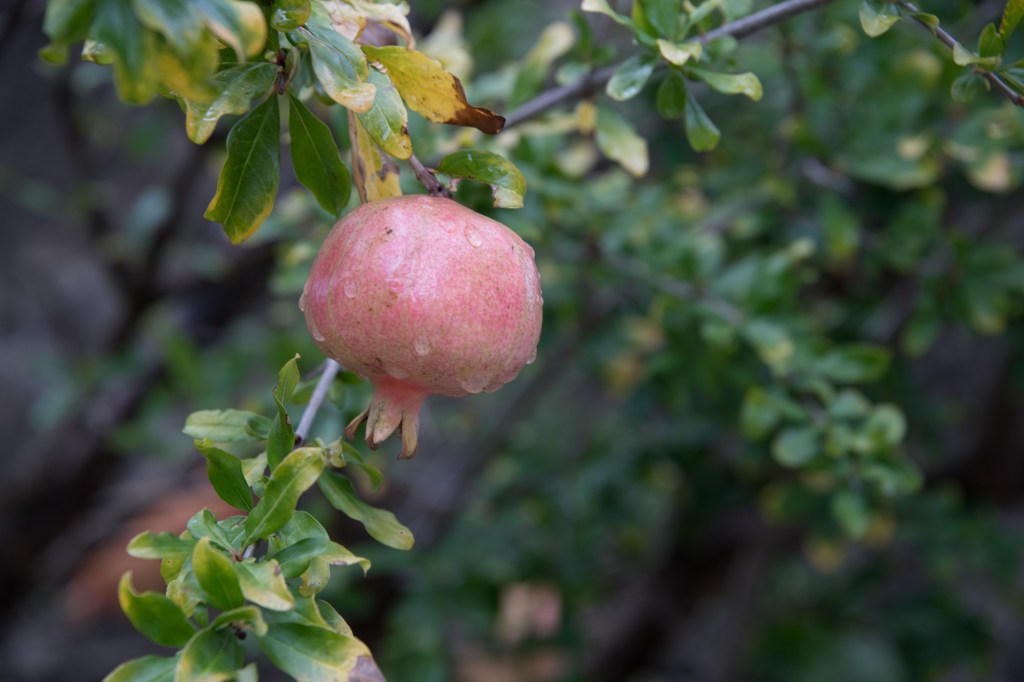
Tu BiShevat Festival (starts on February 10, 2020)

We are delighted to welcome our first guest blogger (of many to come we hope) – Eileen Silver. Welcome, Eileen!

Tu BiShevat – The Jewish Holiday of Trees

by Eileen Silver

Many thanks to Catherine and Lucia for asking me to contribute to their thoughtful and insightful “tree blog”. When Catherine first told me about the blog, I was amazed at the plethora of ideas she and Lucia had amassed for potential blog topics. One topic that I was pretty sure they had not considered though, was the upcoming Jewish holiday of Tu BiShevat, also known as the Jewish new year for trees. No joke! The Jewish people have many celebrations and holidays, and a holiday celebrating trees is indeed an annual event.

So what exactly is Tu BiShevat, and how is it celebrated? Tu BiShevat gets its name from the date on which the holiday occurs, the 15th of Shevat. “Tu” being the Hebrew numerological value for 15, and “Shevat” being the month in the Hebrew calendar that generally coincides with January/February of the civil calendar. This year, Tu BiShevat will begin at sunset on February 10th and end in the evening of February 11th.

In ancient times, Tu BiShevat represented a time of the year in the agricultural cycle in which the Jewish people brought their first-fruit offerings to the Temple in Jerusalem. Produce from fourth-year fruit trees were brought to the Temple in Jerusalem as “first-fruit” offerings, since Jewish law (Torah) forbids Jews from eating the fruit of new trees for three years after they are planted. According to the Torah (Leviticus 19:23-25), the fourth year’s fruit is to be “tithed” (given as a form of offering to God). Tu BiShevat is counted as the birthday for all trees for tithing purposes.

With the establishment of the State of Israel in 1948, the pioneers of the country seized on Tu BiShevat as a day to promote tree-planting efforts in Israel. Particularly in the early decades of the establishment of the State, it was customary for citizens of Israel, as well as Jewish people throughout the Diaspora, to observe Tu BiShevat by planting trees in Israel, or collecting money towards planting trees in Israel.

In modern times, and particularly over the past few decades, Tu BiShevat has increasingly been viewed as an appropriate occasion for Jews to focus on ecological education and caring for the environment, often through teaching of Jewish sources and celebrating nature. For many, Tu BiShevat has developed into an ecological holiday that reminds Jews of their connection to the earth and to their role as caretakers of the environment.

And what would a Jewish holiday be without a celebration of food? It is customary on Tu BiShevat for Jews to eat fruits, particularly fruits associated with Israel. The seven species of “fruits” that are endemic to the Land of Israel are often eaten on Tu BiShevat. They are: wheat, barley, grapes, figs, pomegranates, olives and dates.

olive branch

It is also customary for Jews to try and eat a new fruit on Tu BiShevat, which can be any seasonal fruit that they have not tasted during the year. I generally associate eating carob (boxer, St-John’s -bread) with Tu BiShevat, as it is a fruit grown in Israel that many people eat during the holiday.

Centuries old, the holiday of Tu BiShevat could not be more relevant today! So, whether you practice Judaism or not, as February 10-11 approaches, think about “the holiday of the trees”, and consider doing something special for the environment…. plant a tree, increase your recycling efforts, be mindful about using reusable products rather than single use paper products.

Happy Tu BiShevat to all!

Thank you, Eileen and we wish you “Chag Sameach” (Happy Holiday)!

Good News Story from Sudbury, Ontario

Thank you to reader, Jean, for sharing this good news story about her home town, Sudbury. She (and we) are excited to learn from this Chatham News article about the success that four decades of regreening efforts are yielding now, as evidenced by the return of the “mighty lake trout” to the local habitat.

As regreening program supervisor, Tina McCaffey notes, “We hear all the time – especially through social media – of areas around the world where species are lost and habitats are destroyed…Sudbury is an example to the world of what can be done…It is only in the last few decades – and owing primarily to advancements in mining technology and their cleaner practices – that lake trout have returned to the lakes of the Nickel City…” Read the full story on Sudbury’s sucessful biodiversity action plan at: https://bit.ly/2vhQCRz.

We look forward to welcoming our second guest blogger next week, who will share his family’s experience with installing a solar panel roof.

Tree Tributes

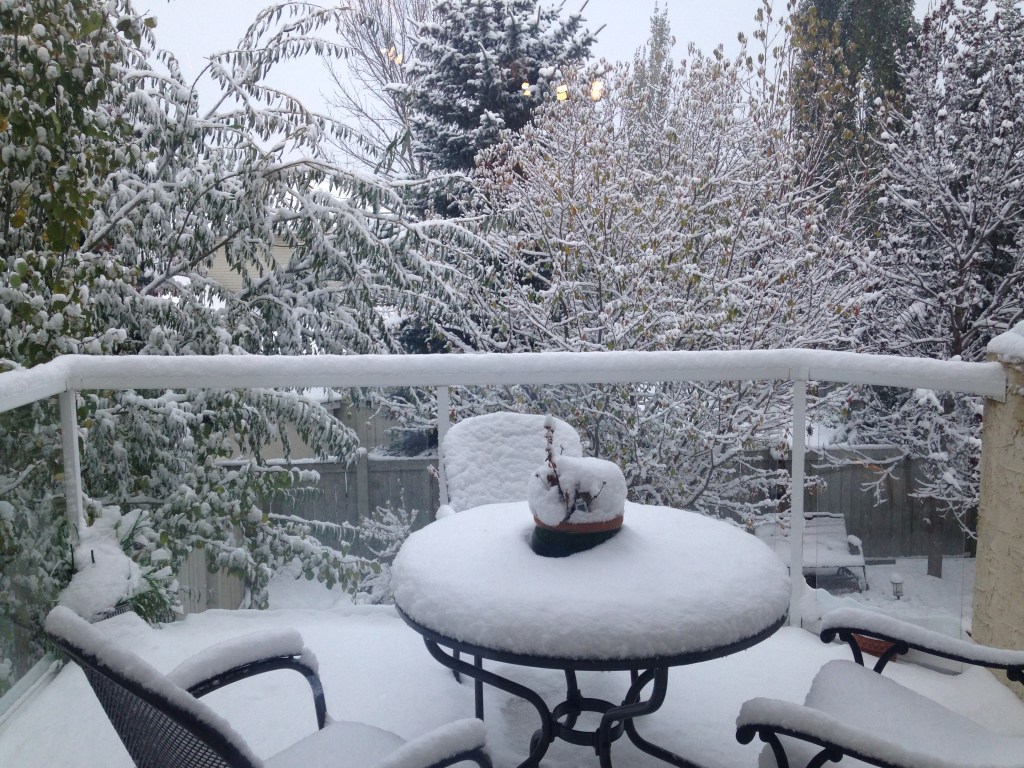
January may seem like an odd time of the year to be thinking and blogging about memorial tree planting, especially when most of Canada seems to be digging itself out from this week’s winter snow storms. What better time than now, however, to be uplifted by thoughts of Spring, renewal, and spring planting, ahead!

The reasons and ways in which to remember and pay tribute to ones we have lost in our lives are countless. Tree tributes offer but one such opportunity to honour the loss of a loved one, or, perhaps to recognize someone we may not have known personally but for whom we owe a debt of gratitude for having made the ultimate sacrifice, as one of Canada’s fallen heroes.

(The sites and organizations we profile below are for our Readers’ information, and not endorsements, as such.)

BC’s Heritage Gardens Cemetery expresses eloquently why tree planting might offer a special kind of memorial –  “Trees are symbolic of the cyclical nature of life. As the seasons change, so do our relationships with those we love. There is no change more personal than the loss of a loved one; it marks the end of their earthly journey, and the beginning of your relationship with their memory. Planting a tree for them is a beautiful way to reflect the significance of their values, or to acknowledge their impact on your life…”

Their website also explains how it works, with illustrating costs, “…At Heritage Gardens we have two gardens allocated for memorial trees and tree burials. Cremated remains may be buried in a bio-degradable vessel, or scattered and mixed into the soil. Depending on your preference, the place may be acknowledged with a memorial tree or plant, type and species of which vary. Basalt columns throughout the grounds will pay lasting tribute to those laid to rest in our gardens and green burial areas. Alternatively, families are welcome to purchase a marker to be placed in front of their memorial plant or tree. The right of interment for the garden costs $650 for scattering or $900 for an urn burial. Trees range in cost depending on size and species. Plants typically range from $55-$85. https://bit.ly/2NEmOVR

Toronto Tree Planting Opportunities

The City of Toronto offers a number of tree-related opportunities for volunteering and/or to plant a commemorative tree. Their website also offers useful lists of trees suitable to the local habitat that might help gardeners plan for their own tree planting, in sunny or shady locations for example.

Typically the City of Toronto has two application windows for its commemorative tree planting program, Spring and Fall. While it is not yet taking applications for Spring 2020, here is the link to the application form in case Readers may want to start planning ahead and saving up: https://bit.ly/30yBk6N

The website states that the application fee is $738 and the donation is tax deductible. The form asks for 1st and 2nd choice of commemorative park location, 1st and 2nd choice of tree, and requested plaque wording of 120 characters maximum.

Here is the list of 12 trees native to southern Ontario that are available for selection https://bit.ly/2NGWxWS.

The City of Toronto also invites volunteer participation to help it reach its goal of a 40% tree canopy, through street tree planting, tree planting and stewardship volunteering, Don Valley Brick Works Ambassador volunteering (May to September), and, Natural Environment Trails volunteer opportunities (May to September). More information is available by subscribing to their mailing list at: https://bit.ly/2R5AJpQ. For gardeners’ information, here is their list of trees that are native to Toronto’s habitat, https://bit.ly/2NFX23A, such as Full Shade trees like Black oak and White pine, and Partial Shade-Shade trees like the Sugar Maple and Maple-leaf Viburnum.

One final opportunity for tree gifting to consider in Toronto, is the University of Toronto’s Landmark Tree Project campaign. Its website states, “Trees contribute to cleaner soil, air and water, and provide vital cooling and shading during summer months. They also improve biodiversity by attracting a greater variety of birds, insects and animals. The Landmark Project adds more than 180 new trees to the Front Campus and areas surrounding King’s College Circle. Join us in making the St. George campus greener and more beautiful by planting a tree.” https://bit.ly/2uakrDl

Other Tree Memorial Options Across Canada

We look forward to being able to profile commemorative tree planting opportunities in the City of Edmonton in future, once it has completed its program review.

Across Canada, Tree Canada, which we have profiled in the past, also offers memorial tree options as part of its National Greening Program. The program is aimed at reforestation and afforestation in areas of need in five regions across the country.  A certificate in memory is issued to donors for each $29 memorial tree donation, https://bit.ly/2NHB2VX.

Thanks to our Readers for pointing out two other tree memorial options across Canada:

Love Lives On, at: https://bit.ly/2RxdAf1

This site profiles its list of 77+ best places for memorial benches and trees in these provinces across Canada – Alberta, British Columbia, Manitoba, New Brunswick, Ontario, Prince Edward Island, Quebec and Saskatchewan.

A Living Tribute, at:  https://bit.ly/3asqu6D

“A Living Tribute was created in 2012 to connect people looking to have trees planted as living memorials or gifts with national reforestation projects. As our goal is to make the world greener through environmental gift giving, every commemorative card that we send out is sustainably sourced, acid-free, REC-Certified and FSC (Forest Stewardship Council) certified.” 

This organization offers tree planting options in Fort McMurray, Alberta; British Columbia; Ontario; Manitoba; Quebec; New Brunswick; Saskatchewan; and the Boreal Forest.

Boreal Forests

Boreal Chickadee

On the topic of the Boreal Forests, did you know they are very efficient as a carbon sink? We learned from this New York Times article, https://bit.ly/365H09u that, “The boreal forests surround the world just below the Arctic Circle, extending through Canada, Alaska, Siberia, and northern Europe. Together they form a giant reservoir that stores carbon dioxide. The boreal forests are different from the tropical forests, closer to the equator. The boreal forests contain about 703 gigatons of carbon in woody fibers and earth, while tropical forest store about 375 gigatons.” (A gigaton is a bit difficult to describe, but it is a lot.) However, these are difficult times for the world’s forests. Think of the fires in Australia and those of last year in the Amazon. Agriculture, logging and urbanization are also taking their toll.

Highway of Heroes

Thank you to Reader Nora for bringing to light this special Memorial Tree Planting Campaign. The Highway of Heroes Two Million Tree campaign has as its mission to, “Honour our Military, Protect the Environment, and Beautify North America’s Most Travelled Highway.” In doing so, it aims to build “the world’s largest living memorial, together.”

Here is part of the moving tribute posted on their website, outlining what inspires this memorial tribute, created initially in 2014, and evolving in 2016 to the two million tree campaign with the inaugural tree planting actions of Corporal Nick Kerr and project co-founder Mark Cullen, “….When a member of Canada’s Armed Forces falls in combat, his or her final journey is along the Highway of Heroes from CFB Trenton to the Coroner’s Office in Toronto.

“We are planting 2 million trees for all Canadians that have served during times of conflict since Confederation and including the war of 1812. 117,000 of the most prominent trees will be planted along and near the stretch of the 401 known as the Highway of Heroes, one tree for every life lost while serving in the Canadian Armed Forces.

“As Canadians we’re proud of our values that guide us to respect green spaces and wilderness, yet too few of us realize we have the highest carbon footprint per capita in the world. We can and will do better.

“They have fought to protect our land and our freedom. It is now our collective duty to protect what they’ve fought for.”

The Highway of Heroes Tree Campaign is a Fund of the Ontario Horticultural Trades Foundation. It is a Registered Charity   https://bit.ly/38fBfY6.

Golden Globe Awards and Wild Fires in Australia and Reforestation

We were pleased at the shout out to global warming given recently by so many actors at the Golden Globes Awards ceremony. Several mentioned the ongoing fires in Australia as another sign of global warming and encouraged fellow actors to donate to Australia and consider changing their personal habits, such as by not flying in their personal jets to awards ceremonies.

The Golden Globes ceremony also served a plant-based meal for the first time.

Here is an article about 15 of the celebrities who donated generously to help Australia Fire Services.    “…Australia is currently being ravaged by bushfires that spread across the country as the regular bushfire season took an unexpected and severe turn. Unfortunately, so far an estimated 8.4 million hectares (21 million acres; 84,000 square kilometres; 32,000 square miles) were lost to flames, alongside 2,500 buildings (including over 1,900 houses). The fires took lives of 25 people (as of 5 January 2020) and there are more gruesome losses of life as it is feared that an estimated billion animals were killed or will die due to starvation and loss of habitat caused by the flames.”  https://bit.ly/2RAit72

If Readers have been thinking about how they might donate to support Australians and Australian habitats to recover from this disaster, here are two options (among many worthy initiatives underway), for information and consideration:

OneTreePlanted is offering a limited edition “I Love Australia” T-Shirt for $15 tree planting donations in aid of Australian reforestation at: https://bit.ly/2TDxp6Z.

The Canadian Red Cross has established a specific Australia Fires Appeal, with the stated commitment that “…the fundraising costs related to any emergency appeal will not exceed five percent.” https://bit.ly/2R8Qexf

World Economic Forum – January 21-24, 2020

We will be watching the news intently this week for coverage of the World Economic Forum (WEF) 2020 being held January 21-24 in Davos, Switzerland. The theme of this 50th edition of the WEF is “Stakeholders for a Cohesive and Sustainable World,” and the Forum will be calling upon companies “to raise their ambitions for climate action.” The annual forum brings together political leaders and business leaders from around the world, with over 3,000 participants attending. 2020 is the fourth year where the meeting will be carbon-neutral.

This 2 minute BBC clip outlines what to expect from Davos this year, noting that the top five risks to be presented and discussed are all environmental (e.g., climate change, biodiversity, extreme weather) https://bbc.in/30F8LEv.

The Global Agenda and a suite of informative and interesting briefs may be accessed here https://bit.ly/2RajlQO.

Here is the link to chapter four  – “A Decade Left: Confronting Runaway Climate Threat” –  in the Global Risks report  that informs the discussions https://bit.ly/36byxl7. A sobering read. More on this and the WEF meeting in in future.

Good News Story for the Week

We end today’s blog post with a climate action good news story from Thunder Bay.

This article profiles Thunder Bay’s plans to be carbon neutral by 2050, at: https://bit.ly/2v4113m.

We find their approach to be incredibly comprehensive as they have hired the company EarthCare to help them meet this goal. You can spend all day in the city’s website https://bit.ly/2NCVjf1, and at EarthCare Thunder Bay’s website at https://bit.ly/2G2nHD9, opening all the informative links. We encourage you to peruse them. Sudbury is also using this company to meet the same targets. We are encouraged to see these commitments at the local level and hopeful evidence that indeed meaningful change is beginning to happen and become embedded in mainstream practice.

One little video on the site compares the carbon footprint of an electric car versus a gas car. Basically, you can cut your carbon footprint in half driving an electric car and as time goes on and Canada uses more clean energy, the electric car will become even more favourable.  We also found a section on podcasts on the website, and that interested Lucia, who shares 6 podcasts here:

Hidden Brain

2050: Degrees of Change

Terrestrial

Science Vs

Outside Podcast

WTF with Marc Maron.

She was impressed with how professionally these podcasts are done and says she learned a lot while walking indoors to deal with Edmonton’s very cold weather. Ahh, the joys of wintertime in Canada!

We both love CBC’s What on Earth? e-newsletter – have you signed up for your free weekly copy yet? This week’s article on electric bikes (e-bikes) as a viable option for going car-free and emissions-free has us thinking….and looking forward to the possibilities that Spring will bring, including warmer bike- and human-friendly weather!  https://bit.ly/38mTpaA

Next week, we look forward with excitement to welcoming and introducting our very first guest blogger.

Innovations-Canadian Made

We were so excited to profile this Canadian innovation story that one reader shared with us, that we changed the topic originally planned for this week. (The Tree Tributes post will now follow on January 23.)

At the start of our blogging adventure we shared the research evidence on how tree planting is one of the most impactful actions that citizens and government can do to slow global warming.

As a world research first, Thomas Crowther et al calculated how many trees are in the world – three trillion – how many more trees could be planted – one trillion – and what the impact of planting new trees on such a scale would be – planting one trillion trees would be sufficient to slow overall global warming to within the 1.5C to 2C maximum rise that scientists advise as necessary if humans want to avert catastrophic and irreversible climate changes that threaten our species’ survival.

These scientists computed that the “lung” capacity of planting new trees on such a scale, in terms of “sinking” harmful carbon dioxide and converting it to clean, life sustaining oxygen, would be equivalent to offsetting all the harmful carbon dioxide emitted by burning fossil fuels over the past 25 years. That’s the good news on tree planting to slow global warming. This message seems to be landing on “fertile” ground and capturing the imagination of youthful entrepreneurs in Canada – more about these inspiring Canadian citizens in just a “flash”.

Photo by Julie Tauber

Two more pieces of Canadian good news on the tree front – as a country, we have more capacity than most for land and environment suitable for tree planting and growth, and, our federal government has recently affirmed the commitment to plant two billion trees over ten years as part of Canada’s climate action plan. (Details yet to be released, however.)

Canadian Drone Plants Trees

Tree planting in actual practice is slow, hard, labour-intensive work. Until now. Thanks to our Reader Edmund, we are so excited to learn about this Canadian drone innovation by Canadian start-up Flash Foresthttps://flashforest.ca/.

Flash Forest states the following as its mission: “Automate. The timber industry has engineered and mastered efficient harvesting technologies, capable of quick clearing with minimal human involvement. Tree planting, on the other hand, still operates with bags and shovels. We can change that. Flash Forest is a reforestation company that can plant at 10 times the normal rate and at 20% of the cost of traditional tree planting techniques. With drone engineering, we bring new levels of accuracy, precision and speed to the reforestation industry. Our goal is to plant one billion trees by the year 2028.”

Here’s what motivates their mission: “Why Automate? According to the International Panel on Climate Change, we have 10 years to reverse climate change and prevent catastrophic run-away effects on our species and civilization. In 2018, 34 billion tons of CO2 was released by humans. This has been increasing since pre-industrial times and surpasses the earth’s natural ability to absorb it. Planting trees is currently the fastest and cheapest way today to sequester carbon. The average tree absorbs 40 lbs of C02 per year. With billions of trees planted each year we can effectively reverse our impact.”

By comparison, here is an instructive 6-minute video called Roots by One Tree Planted on what traditional methods of tree planting look like – still impressive and the main way it is done so far, at the back breaking rate of 1000 tree saplings per day per planter –  https://bit.ly/2TldFoS.

Photo by Lucia MacQuarrie

Flash Forest’s website shows their drone technology pilot testing results to back their claims that they can improve the tree planting rate by a factor of ten, while reducing costs significantly (20% of the cost compared to traditional methods).

One helpful tree graph also seems to imply the answer to a question we and some Readers have been wondering about  – are there certain trees that are best for Canada? Fast Forest is focusing on planting White Spruce, White Pine, Blue Spruce, Red Maple, White Birch, Sugar Maple, Douglas Fir, Balsam Fir.

If anyone is or knows a Soil Ecologist or Botanist, Fast Forest is looking for partner volunteers with these areas of expertise to add to their team.

This is not an endorsement, and as always, we encourage our Readers to do their own due diligence if planning on purchases, donations, investments or, volunteering. Based on their own website disclosure, Fast Forest is garnering a lot of media attention lately, which may be of interest at https://flashforest.ca/press.

Finally, to see what Canadian Tree Planting Drones look like in action in Creemore, Ontario  – pretty cool we think – here is the short two-minute YouTube video by Flash Forest that inspired this blog post! https://bit.ly/3836wh2

Canadians Building a Zero-Emission Concept Car

Trees are a critical part of the equation for carbon capture. Thank you, Trees! Human behaviour shifts, however, hold the key to success for reversing the upward global warming trajectory we remain stubbornly on and for overall success in combatting climate change.

Reducing our reliance on Green House Gas (GHG) emitting fossil fuels for energy, changing our energy consumption practices, including shifting to alternative “clean energy” options, are all important parts of the way forward to a healthier, viable Planet Earth. We wanted to end today’s blog post with one more piece of Innovation good news from Canada about zero-emission electric vehicles.

Thanks to CBC News for putting this story about Project Arrow on our radar. Project Arrow is a new project launched last week by the Automotive Parts Manufacturers’ Association (APMA), in an effort to “demonstrate the strength of the Canadian automotive sector,” by “building a zero-emission concept car entirely designed and made in Canada..” The full article is available at: https://bit.ly/2RaTYxc.

Just how big is the market for electric vehicles (EVs) in Canada we wondered? Bigger than we guessed, though not yet fully realized, according to statistics offered in this February 2019 article, also by the CBC. Apparently, “one in 11 new cars being sold is considered an EV”, and, “more than 11 million Canadians drive to work or a (EV) transit hub every weekday. The article outlines four factors that act currently as barriers to more Canadians switching over to EVs: cost to buy, EV battery range, limited recharging stations, and, time to recharge. https://bit.ly/35JY9oN.

Fortunately, progress toward better access to significantly more EV recharging stations may soon be made in at least one Canadian city we hope, if the recommendations in the December 2019 Dunsky Energy Consulting report – “City of Toronto Electric Vehicle Strategy: Supporting the City in Achieving its TransformTO Transportation Costs,” are adopted.

Photo by Lucia MacQuarrie

We learned about the report and some interesting Toronto EV facts thanks to this CP24 article, https://bit.ly/2Nm9hSm. For example, according to CP24’s highlights from the report, Toronto currently has 6300 electric vehicles registered, “representing about 0.6 per cent of all personal vehicles on city streets…..The strategy says that by 2025 the city should aim to have electric vehicles represent five per cent of all registered vehicles with that number rising to 20 per cent by 2030 and 80 per cent by 2040.”  Transforming car travel in Toronto in such a way, would need to be supported by city investments in “at least 220 fast-charging ports in public locations by 2020 (up from 75 currently) and 650 by 2030…”  To learn more, here is the full Dunsky EV report at: https://bit.ly/2t5j48O.

One closing thought from Norway on zero-emission vehicles, and how forward-thinking government policy and infrastructure investments are making a real difference in promoting and supporting rapid consumer behaviour changes. We subscribe to and recommend this informative CBC newsletter – What on Earth – which comes free by email to our inboxes each week. You can subscribe to What on Earth at: https://bit.ly/2uN8Uu1.

Thanks to What on Earth and a related CBC radio piece, we learned that in Norway last year about 60% of new car sales were electric, with customers on wait lists to buy more, thanks to government incentives that promote EV purchases. These incentives include: no delivery fees paid; no car taxes paid; free EV parking; no payment for charging stations; and EV drivers may use the HOV bus lane- https://bit.ly/383565U. A model worth considering here in Canada we think, and one we plan to ask our elected officials to be sure to investigate as part of improving and accelerating Canada’s climate action plan.

On January 13th, Catherine was delighted to see this billboard while waiting to catch the subway – tangible “signs” of positive climate action underway by the Toronto Transit Commission (TTC). “On A Mission to End Emissions” toward a “zero-emissions fleet by 2040.” Change is taking root!

Thank you for engaging with us in Friends4Trees4Life. We love hearing from our Readers and appreciate all your suggestions, questions, positivity and thoughtful volunteer research help! Please keep it coming.  Next week’s blog post will be on Tree Tributes…we promise.

Personal Change (Part Two)

Thank you Readers for these additional book suggestions:

Trees: A Rooted History, by Piotr Socha and Wojciech Grajkowski, which Goodreads says is, “Part botany, part history, part cultural anthropology—Trees goes beyond the basics to tell readers everything they might want to know about this particular branch of the plant kingdom.

Trees explores the important roles trees play in our ecosystem, takes an up-close-and-personal look at the parts of trees (from roots to leaves), and unpacks the cultural impact of trees from classification systems (like family trees) to art forms (like bonsai trees). Looking forward, Trees also addresses the deforestation crisis. Heavily illustrated in the same style as Bees: A Honeyed HistoryTrees: A Rooted History serves as a beautifully packaged celebration of trees of all kinds.”  https://bit.ly/301nAB8

The Citizen’s Guide to Climate Success, by Simon Fraser University professor Mark Jaccard, is described by Amazon as, “Sometimes solving climate change seems impossibly complex, and it is hard to know what changes we all can and should make to help. This book offers hope. Drawing on the latest research, Mark Jaccard shows us how to recognize the absolutely essential actions (decarbonizing electricity and transport) and policies (regulations that phase out coal plants and gasoline vehicles, carbon tariffs). Rather than feeling paralyzed and pursuing ineffective efforts, we can all make a few key changes in our lifestyles to reduce emissions, to contribute to the urgently needed affordable energy transition in developed and developing countries. More importantly, Jaccard shows how to distinguish climate-sincere from insincere politicians and increase the chance of electing and sustaining these leaders in power. In combining the personal and the political, The Citizen’s Guide to Climate Success offers a clear and simple strategic path to solving the greatest problem of our times.” https://amzn.to/2QZ0Y09

Thank you, Lucy for last week’s inspiring blog post on your New Year’s Resolutions and personal transformative change process to make a difference on climate change.

This is Catherine now,  sharing my learning journey and change process, in the hopes that our Readers may find something of benefit in their own personal process.

Like Lucy, I would say that I too have become much more aware and mindful about how I go about my daily living since we both started this climate action learning and blog writing adventure together last October.

In contrast to Lucy’s holistic and transformative change process, I would characterize my process as a more emergent and evolving one. For example, I have not made specific climate action New Year’s resolutions nor do I have a long-term action plan mapped out as yet, in the way that Lucia has set out her 8% reduction plan per year. I am okay with this difference in approach to our shared goal. We both realize and respect that making a personal climate action plan is just that – it is very individualistic and personal, and depends on a wide array of factors, including the context and circumstances of each Reader’s life. I admire and am very proud of Lucy’s New Year’s resolutions. Her personal plan certainly gives me a model and much food for thought.

My version of Susur Lee’s famous Singapore Slaw

“Food for thought,” is a good transition place for me to start my narrative. Many who know me would know I am a bit of a foodie and that I love all things to do with food and cooking – the Food Network channel, cookbooks, food emporiums and markets, eating out, eating in, dining al fresco (the best!), spices, herbs, recipes, restaurants, aromas, take out, Winterlicious, Summerlicious, celebrations, experimenting, discovering new tastes (hurray for Bibimbap!) and favourite eating spots (delicious Barcelona and Florence), and best of all, the laughter and love that go together with cooking, baking and “breaking bread” together with family and friends. I look forward to many more of these special moments in my life going forward.

At the same time, I am learning about the huge carbon footprint that food waste (personal and commercial) creates. This represents a win-win opportunity for change, I feel, particularly for those of us who are fortunate to enjoy the bounty and richness of choice that is available to us in urban Canada. Reducing or avoiding for food waste is better for budgets, conscience and Planet Earth. Win-win-win. And, as with tree planting, this is a personal action that anyone can take right away and that has positive benefits in combatting global warming, among many other positive outcomes. Beyond purchasing tree saplings as carbon offsets as a regular part of my life now, it is where I am starting to change my behaviours most intentionally and with resolve, motivated by what I am learning for our blog.

Personally, I did not know the extent to which food waste is such a big contributor to carbon emissions and the climate change problem. I just never thought about it that much before, beyond composting and now adopting the practice of using re-usable produce and grocery bags, because I was so focused on the connection between non-renewable fuels as the main source of harmful carbon emissions when used as energy for manufacturing and transportation. This recent, “world-first” report by Canada’s Second Harvest has been an eye-opener for me about the food waste and climate change connection – The Avoidable Crisis of Food Waste: Roadmap.

For example, the report* calculates that:

– every year, “56.5 MM tonnes of carbon dioxide equivalent emissions are created by food waste in Canada.”

food waste and loss (FWL) is a staggering 58% (!) of all the food produced – 35.5 MM tonnes, of which 11.2 MM tonnes (or 32% of what is wasted and lost) could go to support communities across Canada, if rescued

households account for 14% of total waste, more than the 9% generated by hotels, restaurants and institutions as a category, and less than the food waste created by food production (24%) and food processing (34%)

– the annual cost of avoidable food loss and waste in Canada is $1,766 per household (–just imagine having $1700 in extra fun money each year!)

– food waste in landfills creates methane gas which is “25 times more damaging to the environment than carbon dioxide.

____________ (Footnote below)

*Nickel, L., Maguire, M, Gooch, M., Bucknell, D., LaPlain, D., Dent, B., Whitehead, P., Felfel, A. (2019). The Avoidable Crisis of Food Waste: Roadmap; Second Harvest and Value Chain Management International; Ontario, Canada. Accessible from: www. SecondHarvest.ca/Research

Learning about the food waste and methane gas connection is a powerful motivator for me to up my game in terms of doing a much better job of menu planning, shopping and cooking to minimize food waste and loss as a clear goal (of course while also keeping to my ongoing goals of maximizing flavour, nutrition, creativity and enjoyment in my cooking.) The start of a New Year, after all the holiday abundance, seems like a perfect time to begin a more mindful approach to eating in general, with shrinking my carbon footprint (to say nothing of shrinking my waistline!) as an added dimension to healthful and pleasurable eating.

I am also noticing and wondering more about food packaging.

Why do cucumbers need to be covered in plastic wrap, for example? I am happiest in summer and fall when I can buy farm fresh local produce from my neighbourhood pop-up and carry these delicious sun-ripened fruits and vegetables home in their wooden baskets and cardboard containers, no plastic wrap involved.  Now, in the winter months and motivated by what I am learning for our blog, I am opting for unpackaged produce where I can (e.g., loose mushrooms in brown paper bags vs pre-packaged plastic wrapped containers, loose peppers vs pre-packs) and appreciate that clementines come in wooden boxes. I appreciate and am using the re-usable mesh vegetable bags I received as holiday gifts. However, I found that fresh dill and parsley wilt when stored in them, and so for these herbs, I continue to use (and re-use) plastic bags for storage…sparingly now.

Lucy wrote about becoming vegetarian as part of her personal climate action plan. In one of our future blogs we will expand further on what the research says about how shifting to more plant-based diets helps to slow global warming. Becoming fully vegetarian is personally not an option for me for health reasons. However, regularly cooking more meatless meals each week works and already has been part of our household menu plan for some time. That said, I am always on the look out for fresh new delicious low-carbon footprint menu options to add to my repertoire – please feel free to share your favourite recipes and cookbooks :).

One of the biggest personal behaviour changes for me actually started with the decision to co-create this blog in the first place. By nature I am quite private and intentionally had opted out of using social media, wary as well about what seems to me to be still too casual an approach by platforms, providers, organizations and companies to data security and privacy. For these reasons, the fact that I am co-blogging here with Lucy, is a measure of how important I believe it is for me to take personal action on climate change and share what we are learning in the hopes that it may benefit and inspire others along their own journey. For me, jumping into the blogosphere felt momentous.

I am a heat-seeking person by nature. Like Lucy, this winter I too have been wearing more sweaters indoors as we now aim to reduce our household energy consumption, starting by keeping the thermostat between 18-20C this winter. Unlike Lucy, who looks cheery and happy in her new wool poncho, I really do not like being cold and am wearing my extra indoor layers grudgingly, and at times, grumpily. This is a personally challenging and sometimes uncomfortable shift for me to make – I do not particularly enjoy feeling un-relaxed and chilly in my own home.  Change is a process and can be hard sometimes. (I do realize I am privileged to have this kind of change challenge.)  I think I will have a much easier time in the summer when it comes to opting for more low-energy fan use and being a bit warmer (warm being the operative word!) vs. turning on the air conditioner. I am looking forward to learning more about solar panel energy options. I am inspired by what we learned earlier about the people of Eden Mills and their shared goal to become the first community in Canada to be carbon neutral. Solar panels and tree planting are part of their change story!

Living in Toronto probably makes it easier for me to use public transit and walking as my primary modes of transportation than it is for Lucy to make such a shift where she lives. While I enjoy bike riding as an activity, it is not a transportation mode that I personally feel safe using for getting around the city given our current limited system of dedicated bike lanes. So mostly I take the TTC or walk, about 95% of the time. I do still drive, though infrequently. These were my habits long before our blogging adventure, motivated by health and fitness primarily. So, I don’t claim these as climate action behaviour shifts, although now I have even more good reasons to keep on carrying on in this regard. I look forward to learning more from Lucy’s research into electric vehicles, including one hopes, the possibility of electric-powered airplanes in the near future. In the meantime, I am glad to have the option to purchase tree saplings as carbon offsets whenever I fly. Promising signs of industry shifts are beginning to emerge, such as EasyJet in Europe announcing its plans to be the first airline in the world to operate carbon net-zero flights.

It feels odd to tell Readers that I take short showers, but I do. Again, I can’t really claim this as a climate action positive; it is just my habit. Same thing with LED lights. Check. I am happy to know these help. I will think about Lucy’s big change to forgo using the clothes drier. Hmmm. It is very helpful to have the European average of 10.5T CO2 in mind as a reference point as I continue to examine my own carbon footprint more closely.

I do believe in the value and power of citizens speaking up – respectfully and constructively, with a compelling case – to influence the political change agenda. I plan on writing further letters to my elected representatives.

I am committed to our tree planting as positive personal action to slow global warming – all the more so as we witness the alarming devastation and loss of life, livelihoods, homes, forests and habitats caused by the wildfires raging in Australia.

On that note, thank you to our Reader Mary Ann for bringing to light this most inspiring award-winning 16-minute video, about the impact that one self-described “simple man” is making to offset flooding and erosion in India on Marjuli Island, by single-handedly planting trees since 1979, to transform a once-barren area into a forest that is now larger than Central Park. Amazing.

YouTube video of Forest Man, at: https://bit.ly/39NjD7v .

Next week’s blog post will continue to explore the food and climate change connection and profile tree tributes.

New Year Resolutions?

Happy New Year! A fresh new decade is upon us, and a chance to reflect and start anew. We have 2020 vision now.

Although Catherine and I have worked on this blog for only a few months, it has impacted us in ways that we did not expect, and has caused us to make personal changes to our lives for the sake of Mother Earth.  With our blog we started out focused on planting trees and we both have bought trees for gifts, and to offset flights we are taking (using TreeCanada.ca carbon calculator). As well Lucy bought a tree for every small bracelet she sold in December.  We have many more plans for tree events especially as the weather warms up.

We want to share the journey with you about the resolutions we are making for 2020. Change is never easy, but breaking it down into parts, and concrete bits, really helps.  As two individuals with one blog, we have made different changes in our lives already, and so we appreciate and respect how individual this journey is for everyone. Lucy will post her plans for change this week , and Catherine will do the same next week.

This is Lucy writing. My goal in describing my personal life changes since starting this blog is hoping it might inspire any one or all of you to consider changes you might be able to make for the sake of protecting our planet. I have been personally moved by all the reading  I am doing about climate change, about the importance of tree planting and about my own carbon footprint. I have described the personal impact of writing this blog to Catherine as being “life changing”. I no longer look at a purchase or action and think about how much it costs, or how much I like it. I think now about how much it impacts the environment. The good thing about this is I am anticipating having more cash in my pocket, because the ways to cool the earth mainly involve decreasing spending (or spending differently) and living smaller. I am thankful for the many environmentally conscious gifts I received at Christmas, like mesh reusable vegetable bags, bamboo tooth brushes, reusable straws, tree sapling donations, and used books.

My 2020 Resolutions to Reduce my Carbon Footprint by 8%

For 2020 I have decided to go vegetarian, although am debating still about whether to completely remove fish from my diet immediately. I have decided this year to keep the thermostat below 20 degrees (or in the hot weather, keeping it above 25 degrees) , and to not use the drier but hang all the clothes, (except sheets in the winter), and to take short showers, with fewer baths. I am conscious of buying only the things I need, like things that are worn out and need replacing. Buying used is basically guilt free. We have replaced all the lights in the Phoenix house with LED and will look to see which lights need changing in Edmonton. These steps alone I think will decrease my carbon footprint about 8-10% this year.  If I decrease 8% every year for the next 8 years, I hope to cut my carbon footprint in half. In North America, the average carbon footprint is double that of Europeans. I am sure I am among the worst offenders since I drive a big car and have travelled a ton and I maintain two homes. I think the Europeans have an average carbon footprint of 10.5 T CO2  so I am aiming for that,  as my carbon footprint is about double that based on calculations. It is more accurate to use a Canadian based calculator. Not all calculators include the community portion of our carbon footprint.

Eating Vegetarian

Also, looking at all this more globally, world wide emissions would need to start falling by 7.6% annually and continue at that rate for a decade in order for the world to have any chance of hitting the widely accepted targets for stopping global warming. So also setting a personal goal of about 8% reduction a year for 8-10 years seems generally a good thing to do. (Time Magazine December 23-30/2019)

How did I figure out my carbon footprint?

For the most part, I used myclimate.org  carbon calculator which lists the following  7 categories in which you can rate your own behaviour.  You can play around with the calculator to see how much of an impact changing your behaviour would be. That is what I did. Please consider giving it a try. These are their 7 categories and ranking choices:

MEANS OF TRANSPORT: 

-I almost always go public transport, cycle or walk

-I use the car and public transport about the same amount

-I almost always use the car

The LRT in Edmonton

FLYING:

-I never fly

-I fly maximum 2 short distance flights or one long distance flight every couple of years

-I fly one short distance and one long distance in a year

FOOD:

-I only eat vegetarian food

-I eat meat 2-3 times a week

-I eat meat almost every day-mostly from unknown source

SHOPPING:

-I very rarely buy new products, clothes or decorative items

-I buy new products, clothes or decorative things every now and again

-I buy a new appliance, decoration, clothes or shoes every week

ENERGY:

-I live in a building that was built to be energy efficient

-I live in a normal building but I use renewable energy for heating

-I live in a normal building that is heated with oil or natural gas

WARM WATER:

-I generally don’t shower for longer than 5 minutes and I rarely take a bath

-I love standing under the shower for a good 20 minutes, but few baths

-I often have bathes, but I shower less often and my showers are short

HEATING:

-In winter I wear a pullover when I am at home (18-20 degrees C)

-In winter, it is pleasantly warm in my home (20-22 degrees C)

-I can sit in my living room with just a T-shirt  in winter (over 22 degrees C)

Lucy in her wool poncho every day to cope with the reduced temperature inside the house this winter.

I have plans to step up my commitment every year.  I have been reading up on solar panels on the roof on our home in Edmonton. First we would need a new roof. The  government incentives in Alberta are no longer available. We are the third most favourable province for having solar power. The cost initially is at least $20,000. I will learn more about this and then see if we want to invest. I was interested to learn that solar panels in Canada are mostly made in Ontario, but there is a push on for this in Alberta too.

I am starting to think about my transportation habits, as I almost always use my car. I am riding my bike short distances in Phoenix. This is a small change. I am choosing if I really need to make a long drive somewhere, and if so, combine it with other errands. I have looked into electric vehicles, and am asking a lot of questions. I was interested to see that Alberta is not as far along in preparing for electric vehicles as BC, Ontario, and Quebec are. The other provinces have more charging stations. I read that by 2024 the cost of electric cars should be more on par with gas cars, and the batteries are having longer life each year they are made, so I personally am going to wait a few years. If I manage to become a public transit user in the meantime, that would be great, but I cannot envision this unless I move closer to the LRT. In the mean time, my friends, if we are going out to dine or to a show, let’s be sure to car pool.

Of course I am going to have to think seriously about my travels. I do at least 2 medium length return flights a year just seeing my family. That does not even include travel overseas. I am surprised to learn that flight has such a huge carbon footprint.

In general, when making choices, I picked what seemed easiest for me to do first. I look forward to the Canadian government  and industry taking progressive action and making it easier and more affordable to do some of these other things like buying an electric car or buying and installing solar panels. I have written letters to my elected officials twice now, and plan to keep up the pressure to let them know I value these green innovations.

If you search online for ‘carbon calculators’, there are many choices. Some for different countries, for individuals, for small businesses, for school age population, for only household energy consumption, or flights, or any other single aspect of your life, and there are some that offer ways to pay back such as with TreeCanada. The one I used in this blog, myclimate.org included all aspects of my life, including food habits, and also did not require me to pull out all my utilities statements or auto bills in order to make an assessment. It is Canadian too. This appealed to me. To assist you, we will list some of the calculators in our resource section.

Next Week’s Blog

Thank you to our readers for the additional recommendations that came in over the holidays for tree-themed books and a video. We will profile these in next week’s blog post, together with Catherine’s personal change journey which she characterizes as being more emergent and evolving in contrast to Lucy’s experience of transformational change.

Holiday Blog Post

Happy Holidays!

As the songs go — “It’s the most WONDER-ful time of the year.. (Andy Williams),”  and, “It’s beginning to look a lot like Christmas… (Michael Buble)” . In our shared traditions for this special time of year, we both agree! And of course, holiday theme-songs that might be well-suited in particular to our Friends4Trees4Life blog include “Oh Tannenbaum” and Lady Gaga’s “Christmas Tree”.

As we learned for an earlier blog post, December tree-themed festivities, and the use of evergreen trees to symbolize “eternal life” are something shared in history among many societies, tracing back to traditions followed by ancient Egyptians, Chinese, and Hebrews. We learned that Western Germany is credited with the origin of the modern Christmas tree tradition, begun initially as a tradition of setting up a “paradise tree” adorned with apples on December 24th, to celebrate the religious feast of Adam and Eve.

December continues to be a time for many different holiday celebrations around the world and across various cultures, with many celebrations featuring “light” and/or “trees” prominently, including, for example, Hanukkah (the Jewish Festival of Lights from December 22 to 30 this year), Bodhi Day (Buddhists’ celebration of Buddha’s awakening under the Bodhi tree, with traditions of multi-coloured lights and beads on a fichus tree), Scandinavia’s Feast of Juul holiday involving burning a log in the hearth to honour Thor, Yalda (Persian/Iranian celebration of the birth of the sun god Mithra and the victory of light over dark),and Kwanzaa to celebrate African heritage and culture with traditions that include lighting the kinara each day during December 26 to January 1. Lucia understandably was delighted to learn about the Scandinavian celebration of St. Lucia’s Day at this time of year, which includes traditions of girls wearing wreaths with candles on their heads, and making fires to fight off spirits at night. To learn more about these and other winter holiday / solstice festivals you may wish to check this article at https://bit.ly/2YDpZBc.

How to Say Tree of Life in Other Languages

  • Spanish – arbol de la vida
  • French – arbre de la vie
  • German – Baum des Lebens
  • Arabic – shajarat al haya
  • Italian – albero della vita
  • Hindi – jeevan ka ped
  • Anishinaabemowin – Nookomis Giizhig
  • Japanese – Inochi no ki.

Book Recommendations

We’ve received book recommendations from several of our Readers that are tree-themed or climate action-related. Thank you!  We offer them here in case Readers are looking for a good read to curl up and relax with over the holidays.

Richard Powers,  The Overstory. (Pulitzer Prize winning novel)

“The Overstory is a sweeping, impassioned work of activism and resistance that is also a stunning evocation of—and paean to—the natural world. From the roots to the crown and back to the seeds, Richard Powers’ twelfth novel unfolds in concentric rings of interlocking fables that range from antebellum New York to the late twentieth-century Timber Wars of the Pacific Northwest and beyond. There is a world alongside ours—vast, slow, interconnected, resourceful, magnificently inventive, and almost invisible to us. This is the story of a handful of people who learn how to see that world and who are drawn up into its unfolding catastrophe.” https://bit.ly/2Eag1y4

Robert Mcfarlane,  Underland.

“Underland marks a new turn in Macfarlane’s long-term mapping of the relations of landscape and the human heart. From its remarkable opening pages to its deeply moving conclusion, it is a journey into wonder, loss, fear, and hope. At once ancient and urgent, this is  book that will change the way you see the world.” (https://bit.ly/34bLtq3)

“The novel is about nine Americans whose unique life experiences with trees bring them together to address the destruction of forests.” https://bit.ly/2EaWVHS

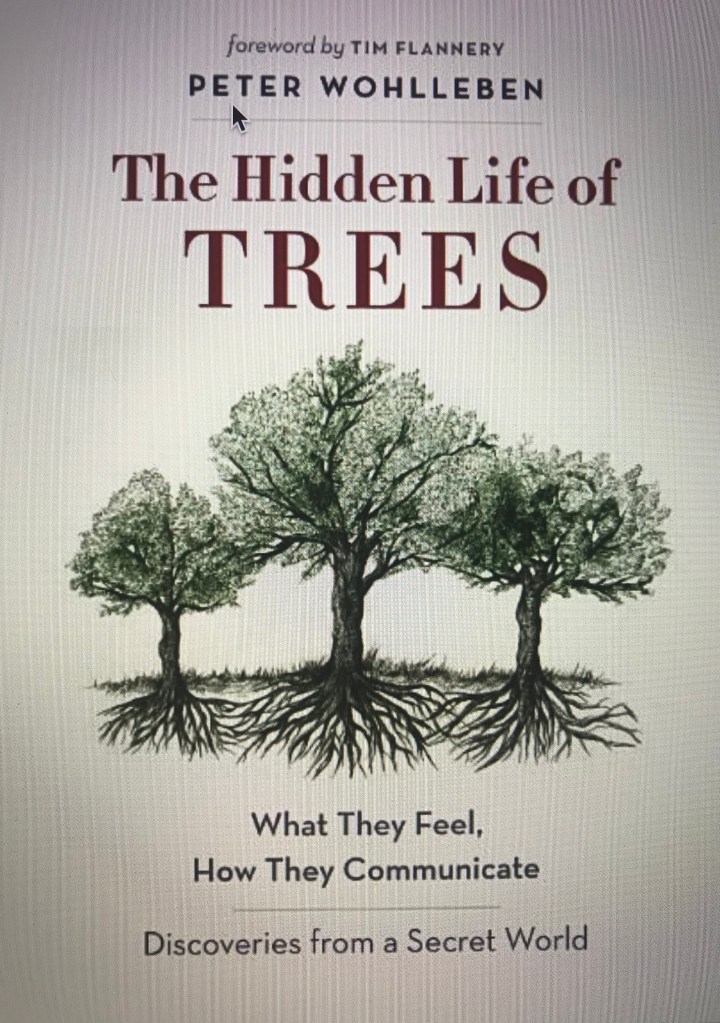
Peter Wohlleben, The Hidden Life of Trees.

 “In The Hidden Life of Trees, Peter Wohlleben shares his deep love of woods and forests and explains the amazing processes of life, death, and regeneration he has observed in the woodland and the amazing scientific processes behind the wonders of which we are blissfully unaware. Much like human families, tree parents live together with their children, communicate with them, and support them as they grow, sharing nutrients with those who are sick or struggling and creating an ecosystem that mitigates the impact of extremes of heat and cold for the whole group. As a result of such interactions, trees in a family or community are protected and can live to be very old. In contrast, solitary trees, like street kids, have a tough time of it and in most cases die much earlier than those in a group.

Drawing on groundbreaking new discoveries, Wohlleben presents the science behind the secret and previously unknown life of trees and their communication abilities; he describes how these discoveries have informed his own practices in the forest around him. As he says, a happy forest is a healthy forest, and he believes that eco-friendly practices not only are economically sustainable but also benefit the health of our planet and the mental and physical health of all who live on Earth.” (https://bit.ly/2E79eFa)

Naomi Klein, On Fire: The Burning Case for a Green New Deal.

Penguin Books says this book is a National Bestseller. A Must-Read book. Naomi Klein pairs a decade of her powerful writing on our acute environmental decline with new material on the staggeringly high stakes of what we choose to do next; and inspiringly offers here a politically viable, just, sustainable path forward.”  https://bit.ly/2PdXUxm

Michael Christie, Greenwood

A magnificent generational saga that charts a family’s rise and fall, its secrets and inherited crimes, and the conflicted relationship with the source of its fortune—trees—from one of Canada’s most acclaimed novelists https://bit.ly/2LSiNfl.

We found this Goodreads’ description of Greenwood to be an intriguing hook for wanting to learn more about the characters in this family – “It’s 2034 and Jake Greenwood is a storyteller and a liar, an overqualified tour guide babysitting ultra-rich vacationers in one of the world’s last remaining forests. It’s 2008 and Liam Greenwood is a carpenter, fallen from a ladder and sprawled on his broken back, calling out from the concrete floor of an empty mansion. It’s 1974 and Willow Greenwood is out of jail, free after being locked up for one of her endless series of environmental protests: attempts at atonement for the sins of her father’s once vast and violent timber empire. It’s 1934 and Everett Greenwood is alone, as usual, in his maple syrup camp squat when he hears the cries of an abandoned infant and gets tangled up in the web of a crime that will cling to his family for decades.” https://bit.ly/35fdoGU

Videos and Documentary Recommendations

On YouTube : Iceland Christmas Animated Video. (for the whole family)  – “Don’t buy products with palm oil- stop cutting down the rainforest”  at, https://bit.ly/2sofdmf.

On YouTube:  Team Trees: A Blogger Fundraises to Plant 20 Million Trees, at: https://bit.ly/2RKvJYG.

On You Tube: What Trees Talk About, David Suzuki.

This Nature of Things episode on What Trees Talk About takes a revealing look at the secret lives of trees-how they communicate, wage war, and work together to transform the world. https://bit.ly/35n5Kui.

Planet Earth – An 11-series Documentary by Sir David Attenborough

The BBC writes that, “Sir David Attenborough is one of the world’s best-known and admired wildlife film-makers. His incredible career watching wildlife as a naturalist and broadcaster has spanned nearly six decades. There are very few places on the globe that he has not visited.

“Over the last 25 years he’s worked with BBC teams on many landmark BBC series, of which ‘Planet Earth’ was one of the highlights. His first major series “Life on Earth” was watched by an estimated 500 million people around the world. His series are a benchmark of quality in wildlife film-making and have influenced generations of documentary film-makers.” https://bbc.in/2tahu58. The BBC’s Planet Earth video clips link: https://bbc.in/2YGWs9V.

Board Games

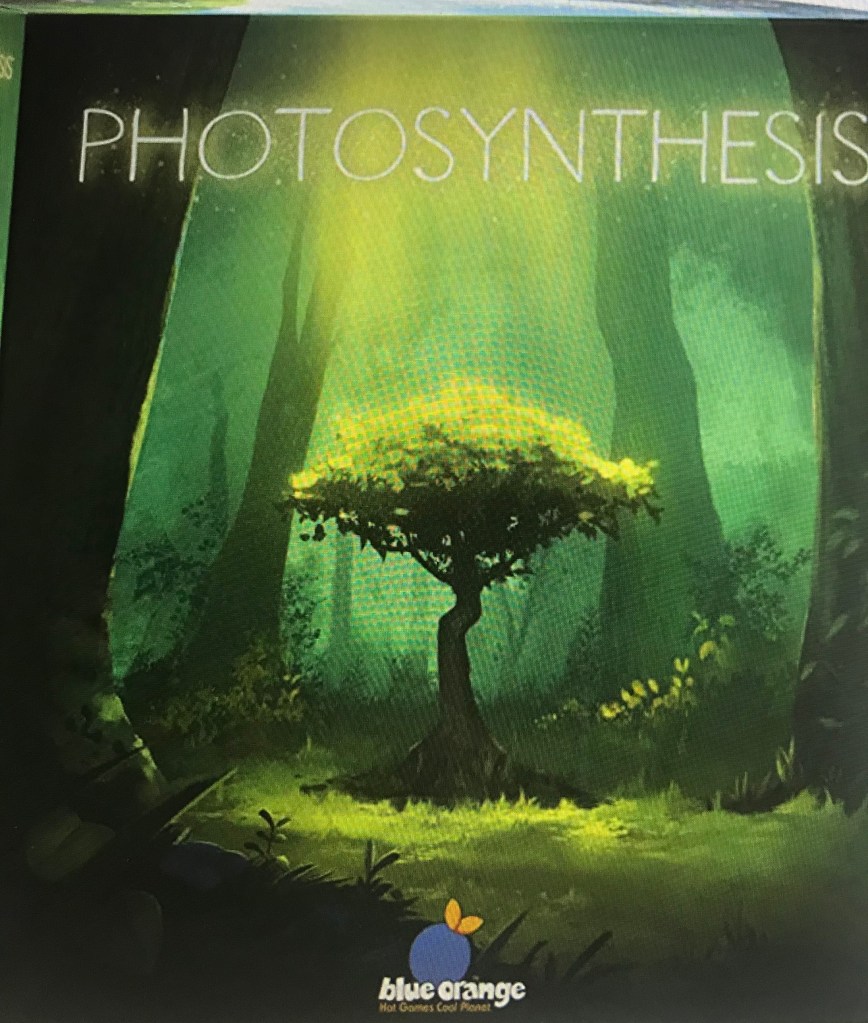
Blue Orange Games Photosynthesis Strategy Game

Friends4Trees4Life has found this cool, award-winning board game that we think is a perfect way for the whole family to have fun together learning about photosynthesis. This board game review and visuals have us hooked and keen to play:

“In Photosynthesis you are sowing the seeds to grow a beautiful woodland. As the sun moves around the board each day, you will harvest more sunlight with larger trees, which might overshadow others in the forest.

“Just by seeing the first images of Photosynthesis we knew it was a game we had to try. When it arrived, I relished the opportunity to punch out and assemble the cardboard trees that make this game look just as good, if not better, than most plastic miniatures games I’ve seen.

“Photosynthesis has been winning awards for its presentation, but everything about that presentation is core to the gameplay – which is a fantastic feat for an abstract game.

Photosynthesis Gameplay

“At the start of the game each player will take turns planting a tree until everyone has two small trees along the outside of the board. Every round of the game, each tree that isn’t obscured by shadow will generate sunlight, which acts as a currency to grow and spread your trees…..” Read more at: https://bit.ly/2PBHm19.

Shopping Carbon Negative? Sheep Inc. Merino Wool

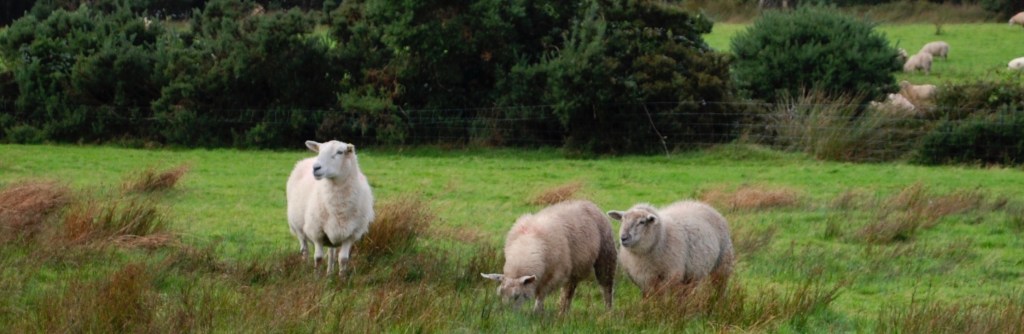
Get cozy and be the first in your circle to wear the world’s first “carbon negative” clothing item – a Merino Wool Sweater from New Zealand’s Sheep Inc.

According to this l’Officiel description, “Sheep Inc. aims to be carbon-negative without sacrificing quality. Their sweaters use 100% Merino wool, which is then hand-spun into yarn and dyed in northern Italy at a mill that employs a number of sustainable practices including sourcing all of its power from renewable energy. 

“Like other brands going carbon neutral, Sheep Inc. will be carbon offsetting, which is the practice of cutting carbon emissions to counteract the emissions that are unavoidable. To be carbon-negative, the brand is going the much-needed extra mile and offsetting more than it actually emits.

“Because of the urgency of the climate crisis, Sheep Inc. has decided…to offset ten times their emissions,” said Mark Maslin, advisor to Sheep Inc. and the head of climatology at the University College London. “  Learn more at: https://bit.ly/2PBxy7B, or via Sheep Inc.’s website at https://sheepinc.com/. (Apparently, they even give you a sheep!)

Blog Holiday Hours

We’ll be taking a brief holiday break ourselves – so we won’t be posting on December 26. Our next post will be on Thursday, January 2, 2020. We hope there will be lots of news to update our Readers about global climate action plans coming out of the annual UN Council of the Parties’ meeting which wraps up on December 13, 2019 in Madrid.

Until then, we thank everyone for engaging with us at Friends4Trees4Life. We wish all our Readers a Happy Holiday and a very Happy New Year! See you again in 2020!!

Tree Joys and Benefits

Imagine mornings, without coffee, orange juice or birdsongs. Or Thanksgiving dinners without apple pie. Weekend brunches of waffles, pancakes and French toast, minus maple syrup (perhaps substitute cactus agave?). Childhood memories of winter family outings into the bush, without the magical moments of sugaring off and the heady aroma as maple sap turns into syrup, or, camping and cottaging memories without the snap, crackle, pop of a brightly burning camp fire to sing and toast marshmallows around.

Banana splits, sans les bananes? Would marzipan be marzipan, minus the almonds? What of iconic images of tropical paradises of sun, sand and surf, without the swaying palm trees? What would August be like every year, without the prospect and pleasure of juicy, sun-kissed, tree-ripened peaches to anticipate?

Yes, human nutrition and experiences would be greatly diminished without these and many more bounteous edible offerings and simple pleasures that trees offer to us. To say nothing of the habitats they provide for insects and animals around the world. In fact, according to Science Daily at https://bit.ly/357p6U2, one third of the world’s crops depend on pollination by insects and other pollinators that live in trees.

The world’s oldest boat building site is 8000 years old according to this Telegraph article at https://bit.ly/2PsKDzX. Would naval travel have taken longer to emerge in our history, if not for trees? Without trees, what would replace the iconic birch bark canoe in our Canadian imagination and cherished memories of northern canoe paddling adventures, real or imagined?  What subjects would have inspired the Group of Seven’s paintings? https://bit.ly/2s8OsCs

Of course, human evolution would have taken place still without trees. Just differently. And yielding different (but still pleasant) memories.

Imagine if Canada might have chosen to enshrine the beaver or loon perhaps on our own flag when creating it for the first time in 1965, had maple trees not existed. How would this saying be transformed – “As American as mom and apple pie,” – in a world without apple trees? And, what would have prompted Sir Isaac Newton to ponder about gravity in the absence of this now famous apple tree? https://bit.ly/2RCjT2C

Photo:MaryAnn Griffin

Robert Frost would have needed new inspiration and a different title to pen his poem, The Sound of Trees, https://bit.ly/2RzmbiV, and Joyce Kilmer’s famous poem which begins “I think that I shall never see A poem lovely as a tree….,” would literally be true in a world without trees, https://bit.ly/2rtxWgf . Would Shel Silverstein have been inspired to write The Giving Tree, we wonder?

One of our favourite Impressionist artists, Claude Monet, might not have given the world the beloved Water Lily series of paintings, if not for the inspiration of the many willows in his gardens at Giverny. We found this site which offers images of 10 famous artworks inspired by nature, some featuring trees prominently, https://bit.ly/2YCoZxm.

Our imaginations and spirits can find inspiration in trees. Our hunger can be fed and nourished by the fruit they bear. And literally, trees keep us alive through the life-giving oxygen they produce. If that weren’t enough service, when we humans pollute the air we need to breathe to survive, trees act as “sinks,” capturing and absorbing life-threatening carbon dioxide emissions and converting them through photosynthesis to clean oxygen and nutrients. Pretty awesome powers and gifts to the world we think as we paused for a moment to consider trees anew, in writing today’s blog post.

Even five minutes around trees may improve health, says this New York State website, https://on.ny.gov/2RzdjKj. It goes on to list these additional health benefits, and at the bottom of the page, provides the reference list of scientific papers to back its findings, “Exposure to forests and trees:

  • boosts the immune system
  • lowers blood pressure
  • reduces stress
  • improves mood
  • increases ability to focus, even in children with ADHD
  • accelerates recovery from surgery or illness
  • increases energy level
  • improves sleep.”

Additional health benefits, plus the supporting research, are described in this US News report, https://bit.ly/2sciYuY, and include asthma reduction, and a large-scale study which found that trees and greenery may even boost life span

Tree Canada’s website elaborates on Tree Benefits, noting that one in four pharmaceuticals are plant-based, including extracts from the yew tree which are used for the chemotherapy drug Taxol, https://bit.ly/38iEwqu. In its extensive list of tree benefits, Tree Canada also offers this useful reference point as we are learning and thinking more about our own carbon footprints – “You need about 500 full-sized trees to absorb the carbon dioxide produced by a typical car driven 20,000 km/year.” 

This US study reported on the health and economic benefits of trees ($1B benefit to California from the presence of street trees) by comparing and contrasting two cities in California, one with an urban tree policy, and the other, without one https://bit.ly/2rkrHeR. The UK’s Guardian reports on research on the health benefits of living on tree-lined streets. It also discusses the Japanese practice and government health policy of shinrinyoku – literally forest bath – and its power “to counter illnesses including cancer, strokes, gastric ulcers, depression, anxiety and stress,” which western doctors are now discovering and agreeing on as benefits for human health and well being by mindfully spending time under a tree canopy and “getting back to nature,” even in urban settings https://bit.ly/36tKm6P.

T-shirt: Etsy-Hibiscus Oak Designs

Finally, for the avid researcher, or for Readers who want more evidence, here is a link to a literature review on the scientific benefits of trees by the Chicago Region Tree Initiative on its website at http://chicagorti.org/TreeBenefits.  Our main take aways from writing this blog, are that tree benefits are powerful, personal (boosts life spans!) and planetary (essential to fighting global warming). Our “triple P” case for Tree planting!

Trees have brought us joy in many forms, either directly or indirectly. They have provided food, and sustained the life cycle as we know it. But that is not to say that, without trees, or with a limited number of trees, our lives would be less memorable. The memories would just be different. The point we think is that, in the future, we humans may destroy the opportunity to enjoy all the nutrition, activities, memories and life-sustaining clean air benefits that trees have provided us over the years. For millions of years evolution has been supported, fed, and nurtured by trees. In order to continue to be able to enjoy our historic pleasures, live and recreate fond memories, we need trees. Plain and simple. (Plus, human beings still need to do our part to change lifestyles and keep innovating economic practices in order to reduce greenhouse gas emissions, dramatically and with urgency).

T-shirt: Wholesome Culture

On that note, we were pleased to see that Climate Action got its own section in the federal government’s December 5, 2019 Speech from the Throne, including confirmation of Canada’s commitment to plant two billion trees as part of the country’s plan for meeting our 2030 and 2050 targets under the UNFCCC https://bit.ly/36jB8tK.

This December 9th UN Climate Change update reports on promising steps being taken among members of the global data community for a common framework for “tracking the climate action of regions, cities, businesses, investors and initiatives which can help with the effective implementation of the Paris Climate Change Agreement,” https://bit.ly/348a6DU . We’ll be watching for, and reporting back to our Readers on, the COP 25’s Closing Press Release expected on December 13, 2019; here’s hoping global leaders make rapid progress in converting their rhetoric into meaningful climate action for achieving a 1.5C carbon-zero Planet Earth asap.

Next Thursday’s post will be in keeping with the festive holiday spirit. We plan to offer tree-themed reading ideas from our Readers, and more, for those who are looking to relax and curl up with a good read over the holidays….then, we too will take a brief holiday break ourselves – so no blog post on December 26th. We’ll be back with our weekly post on Thursday, January 2, 2020. Please go anytime to our blog to check the Resources and other pages. We added a link in Resources to the blog: Spud.ca where you can see 5 cute tabletop Christmas tree alternative options. Thank you to our readers for giving us this link and others.

How Does the World Agree on Climate Action?

How do 197 sovereign nations agree on the need to row in the same direction on climate action to slow global warming to 2 degrees Celsius or ideally 1.5 degrees Celsius?

Since the UN is at its annual meeting on climate change this week (December 2-13, 2019), we thought some Readers might want to know a bit of background on the UN multilateral process that has been in place since 1994 (admittedly, it’s a dry topic with perhaps more appeal to policy wonks, historians and research types).

To start, here’s a one minute UN video clip with highlights of some innovative Lighthouse projects that are part of this international climate action work  https://vimeo.com/305547126.

The 197 governments, known as “Parties to the Convention,” each have ratified, and agreed to work under, the United Nations Framework Convention on Climate Change (UNFCCC) which provides the foundation for “multilateral action to combat climate change and its impacts on humanity and ecosystems. The 1997 Kyoto Protocol and the 2015 Paris Agreement were negotiated under the UNFCCC and build on the Convention.”

The ultimate objective of the Convention is to stabilize greenhouse gas (GHG) concentrations “at a level that would prevent dangerous anthropogenic (human-induced) interference with the climate system.” It also states that “such a level should be achieved within a time frame sufficient to allow ecosystems to adapt naturally to climate change, to ensure that food production is not threatened, and to enable economic development to proceed in a sustainable manner.”

Since 1995, these 197 governments have met annually as the Conference of the Parties (COP) “to take stock of their progress, monitor the implementation of their obligation and continue talks on how best to tackle climate change.”

The Intergovernmental Panel on Climate Change (IPCC) supports the COP by setting principles, legally-binding emission reduction targets for developed countries, technology transfer mechanisms, funding mechanisms, and by commissioning research and assessments and more. It requires Parties “to develop a national inventory of Green House Gas (GHG) emissions and to report on their mitigation policies and measures” by filing and updating Nationally Determined Contribution (NDC) reports.

Of the 197 UNFCCC signatories, currently, 184 countries have filed Nationally Defined Contributions (NDCs), available at https://bit.ly/2OY9zz3. Canada’s, which we understand has yet to be formalized, is here, at https://bit.ly/2OzZg5i. More about Canada’s plan in future blogs.

These highlights are from “ Understanding the United Nations (UN) Climate Change Regime” – Please take a look, at https://bit.ly/2OYyJh6.

  • There is clarity on the science informing the need to act. This includes a 2014 synthesis report by Working Group 1 (WG1) looking at the science of climate change which is “categorical in its conclusion: climate change is real and human activities are the main cause.” Further, for the first time WG1 estimated cumulative carbon dioxide (CO2) emissions since pre-industrial times – (CO2 being the most abundant GHG that has resulted, in particular, from burning fossil fuels) – and provide(d) a CO2 budget for future emissions to limit warming to less than 2C. About half of this CO2 budget was already emitted by 2011.”
  • “From 1880 to 2012, the average global temperature increased by 0.85C.”
  • “Given current concentrations and ongoing emissions of GHGs, it is likely that the end of this century will see a 1-2C increase in global mean temperature above the 1990 level (about 1.5-2.5C above the pre-industrial level). The world’s oceans will warm and ice melt will continue. Average sea level rise is predicted to be 24-30 cm by 2065 and 40-63 cm by 2100 relative to the reference period of 1986-2005. Most aspects of climate change will persist for many centuries, even if emissions are stopped.”
  • As there is a direct relation between global average temperature and the concentration of greenhouse gases in the atmosphere, the key is “mitigation”. This means reducing emissions and enhancing “sinks”(e.g., increasing the area of forests). Trees matter!
  • “Climate change is inherently global in nature. The composition of the world’s atmosphere is impacted by GHG emissions for countries around the world, and the effects of those changes affect everyone.”
  • “The Convention puts the onus on developed countries to lead the way. As they are the source of most past and current GHG emissions, industrialized countries are expected to do the most to reduce emissions, that is, to implement measures to mitigate climate change.” These developed countries are referred to as Annex I Parties, and encompass all of the 1994 members of the OECD and include 12 countries with economies in transition from Central and Eastern Europe.” In its Annex B, the 2005 Kyoto Protocol “sets binding emission reduction targets for 36 industrialized countries and the European Union. Country lists and their ratification status, are here at https://bit.ly/2qg9pKY.
  • “The Paris Agreement’s (2015) central aim is to strengthen the global response to the threat of climate change by keeping a global temperature rise this century well below 2 degrees Celsius above pre-industrial levels and to pursue efforts to limit the temperature increase even further to 1.5 degrees Celsius. Additionally, the agreement aims to increase the ability of countries to deal with the impacts of climate change (adaptation), and at making finance flows consistent with a low GHG emissions and climate-resilient pathway.” Other essential elements are: long-term temperature goal; global peaking; mitigation; sinks and reservoirs; loss and damage; finance, technology and capacity-building support; climate change education, training, public awareness, public participation and public access to information; transparency, implementation and compliance; global stock take; Decision 1/CP.21”.
  • “There will also be a global stock take every 5 years to assess the collective progress towards achieving the purpose of the agreement and to inform further individual actions by Parties.” (The next global stock take will be in 2023.)
  • “United Nations climate change conferences have grown exponentially in size over the past two decades …. and are now among the largest international meetings in the world.”

Access a three-page Closing Press Release from the special Climate Action Summit 2019, held in September in New York here, https://bit.ly/2DuwgFE. Closing highlights include, “65 countries and major sub-national economies such as California committed to cut greenhouse gas emissions to net zero by 2050, while 70 countries announced they will either boost their national action plans by 2020 or have started the process of doing so…..Many countries and over 100 cities – including many of the world’s largest – announced significant and concrete new steps to combat the climate crisis…Many smaller countries, …., were among those who made the biggest pledges, despite the fact that they have contributed the least to the problem…Countries, including France and New Zealand, announced they will not allow oil or gas exploration on their lands or off-shore waters….The European Union announced at least 25% of the next EU budget will be devoted to climate-related activities…87 major companies with a combined market capitalization of over US$2.3 trillion pledged to reduce emissions and align their businesses with what scientists say is needed to limit the worst impacts of climate change – a 1.5C future…The Summit also delivered critical platforms for improving energy efficiency and reducing the growing energy needs for cooling…”

The UNFCCC annual meeting is currently underway in Madrid, Spain, December 2 – 13, 2019. The agenda and emerging proceedings are here, at https://unfccc.int/cop25.

Thank you for reading this long Blog post. Next Thursday’s post will profile additional benefits of trees, beyond their critical role in carbon capture, plus any relevant press reports on, and releases by, the UNFCCC annual meeting for 2019. We’ll also start to look more closely into Canada’s plan.

Holiday Trees and Report Card on Leading Countries

Ever wonder about the origins of the Christmas tree tradition? We were surprised to learn that the use of evergreen trees to symbolize eternal life goes back to ancient Egyptians, Chinese and Hebrews as a custom, while western Germany is credited as the origin of the modern Christmas tree tradition which was set up in homes on December 24th and strung with apples to symbolize a “paradise tree” in celebration of the religious feast of “Adam and Eve”. (For more history on this, click here for the Britannica Encyclopedia site, https://www.britannica.com/plant/Christmas-tree, and, stay tuned for a special guest blog in February 2020, on the origins and meaning of the Tu B’Shevat Tree Festival in Israel).

Living Christmas Trees:

Have you considered buying a Christmas tree that you could later plant in your yard? Here’s what we have found so far on this option in the Toronto GTA.

Sheridan Nurseries in and around Toronto carries these varieties:

  • 4’-5’ Blue Spruce for $299.
  • chubby  3’-4′ Blue Colorado Spruce for $150
  • 3’-4’ Norwegian Spruce ON SALE for $70.

We did a thorough search and could not find such trees for sale in Edmonton, so let us know if you have seen this available. There are places like LLBean selling table top trees of 18”-24”, and  we have seen those for sale many places.

If a living tree is a new holiday tradition you would like to explore, please review this information on choosing the best tree for your planting location, and caring tips for the survival of these trees. For example,  they should be inside up to 10 days only, and eased outdoors – Please read full care tips at, https://bit.ly/2XF0SNP.

Gifting Tree Saplings:

One Tree Planted: 11 Reasons to Gift a Tree

  • 1. It is a unique gift
  • 2. Good for the environment
  • 3. Will last a lifetime 
  • 4. Gives animals a home
  • 5. Cleans the air
  • 6. Benefits future generations   
  • 7.Helps end hunger
  • 8. Keeps people safe
  • 9. Saves money
  • 10. Reduces waste
  • 11. You can’t go wrong.

See our menu section on Tree Planting and Donating and check out TreeCanada ($4- per sappling) and One Tree Planted ($1 USD a sappling), two sites we have used to purchase bulk trees for gifts. We have bought some for a Christmas gift and received a certificate, and the person receiving this gift will also receive a certificate just before Christmas. Tree Canada issues tax receipts. These sites are so great to go through, to get the scope of all the things they are doing. For example, we both plan to buy tree saplings whenever we fly, for more peace of mind as we intentionally begin to offset our carbon footprints.

There are other great sites too. One is Arbor Day, and a Canadian Site: Forest Recovery Canada, an arm of Forests Ontario. They sell trees too. See menu: “Tree Planting and Donating” for more details about these two.

Of course Readers are encouraged to do their own due diligence to feel assured that these or other sites are legitimate non-profits, and are not only planting trees, but choosing the best sites and ensuring the best possible success of the trees. 

We realize that a living tree may not be a good option for everyone. Rest assured that there is good news about the tree benefits of live cut trees that we want to share from this Home Depot site (although not intended as an advertising promotion or endorsement).

Live Cut Trees: Home Depot’s View on the Environmental Benefits

“Live Christmas trees are a renewable resource, with hundreds of thousands of acres dedicated to their growth. Christmas tree farms raise and harvest different varieties of trees, virtually eliminating the harvesting of trees in the wild, which can deplete valuable forests.The average tree takes approximately seven years to reach maturity, and for every tree that is harvested, anywhere from one to three more seedlings are planted. Learn more about the benefits of real versus artificial Christmas trees with our guide.Recycling programs located in most communities turn your used tree into useful mulch. Many Home Depot locations across the country offer Christmas tree recycling free of charge. Call your local Home Depot store to find out if they are participating. In some areas, recycled trees are also being used to create habitats for fish and other aquatic life in local ponds and lakes, as well as helping to slow erosion.” https://thd.co/2KIv45q.

Eco-Friendly Coffee

Another holiday gift option that is tree friendly is purchasing coffee that is grown under tree canopy. You may find it locally, but we were able to order it online through the Audubon Society. There are various sites selling this coffee. Because the coffee is grown without clear cutting, it has the added benefit of being bird friendly.

The Climate Change Report Card: The Countries that are Reaching the 1.5C Target

Just a few countries get an A grade as they are meeting the target towards their contribution to not exceeding 1.5C in temperature rise overall globally, as written in this 2019 article by National Geographic, at https://on.natgeo.com/2qDIBV7.

  • Gambia, Africa: restored 10,000 hectares of forest; gets 1/5 of energy from a  renewable photovoltaic plant
  • Morocco: has  42% renewable energy with solar power fields the size of 3500 football field
  • India: will have 40% renewable energy by 2030 and likely much sooner
  • Costa Rica: has  almost reached 100% renewable energy (2021) and has a moratorium on oil and gas from 2020 until 2050; every two years will replace 5% pf public transport to electric busses and 10% taxis
  • Getting a C Grade:  EU – set target for 32% renewable energy by 2030; inspite of this, the EU is not on track for 1.5 degrees but rather 2 degrees; Sweden – will have  49% renewable  energy by 2030;                    Norway: 60% of new cars are electric and their electricity is 96% renewable; is investing $1 Trillion in renewable stocks and taking out $13 Billion from oil and gas stocks; 60% of new cars are electric and their electricity is 96% renewable
  • Canada does not even get a C grade but rather is scored as “insufficient” because we are going towards >3C.

Personally, we find what countries like Costa Rica or Norway and Sweden are doing on policies such as renewable energy, electric cars and green investments to be promising directions for Canada to consider. Now that a new federal cabinet is in place, with Jonathan Wilkinson appointed as the Minister of Environment and Climate Change, Readers may want to consider letting him and/or their elected representative know their views on global warming and climate action. For example, see the Resources menu item for a sample Member of Parliament.

Next week’s blog post will look into Canada’s current Pan-Canadian Framework on Clean Growth and Climate Change, as we begin to turn attention to the bigger picture of the international community’s forty-year long commitment, through the United Nations’ Paris Accord, on global warming and climate change. See you next Thursday!